


Let the smart home take care of the vacation home
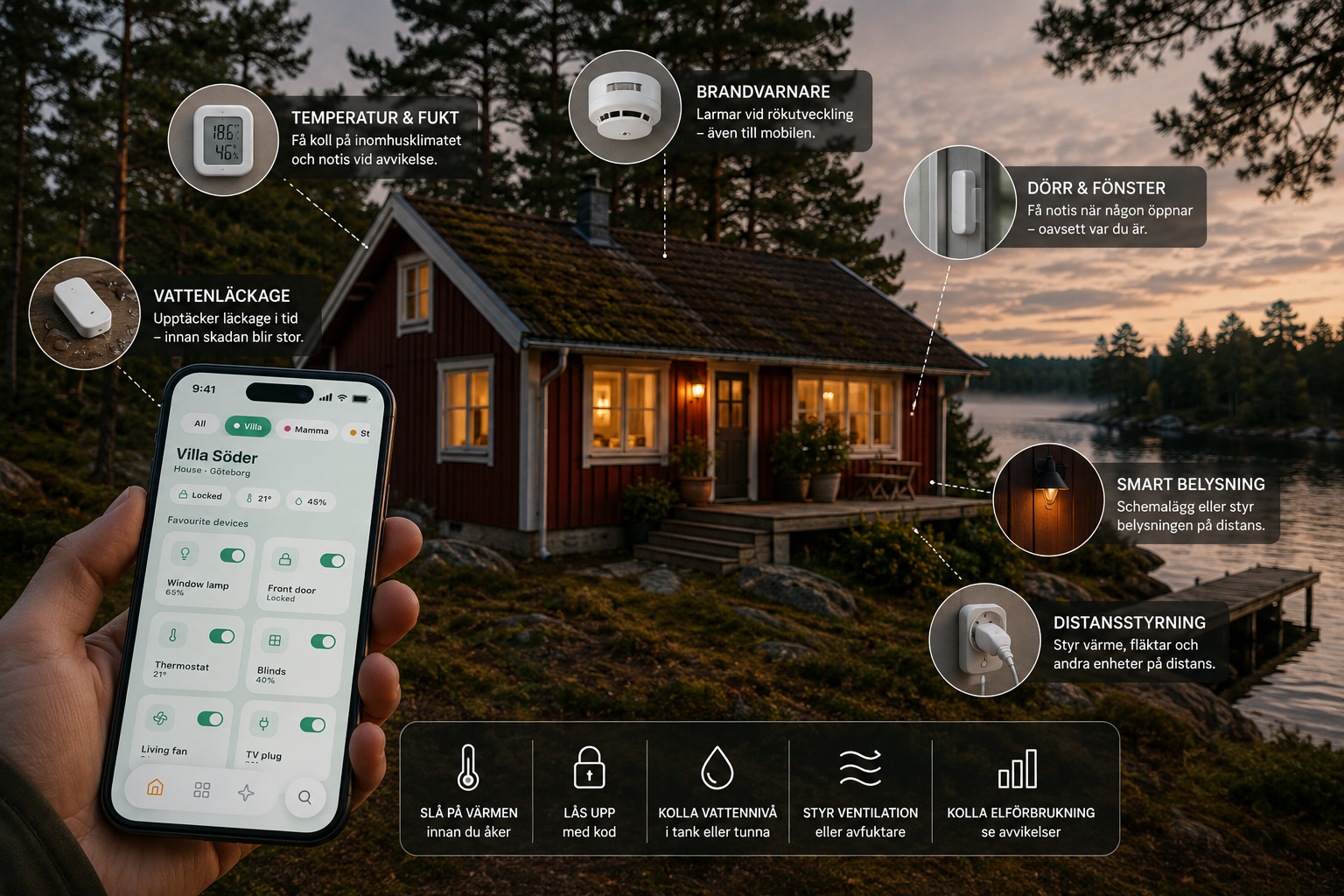
How smart home technology has made it practically possible to manage the cottage remotely — and what that opens up.
The classic Swedish holiday home requires a lot of driving. You drive there in the spring to open it. You drive there in October to close it. You drive there in November to check that the radiators are working. You drive there in February to shovel the roof. You drive there in March to see if it really has leaked after that storm that blew through.
The driving is part of the charm. But a lot of it is also just worry that has become routine.
That is where modern smart home technology has made a real difference. Not because it is cool. But because it lets you know what is happening there without you having to go there.
Temperature and humidity — the foundation
The two most important values to keep an eye on in a holiday home are temperature and humidity. If the temperature falls below zero when the radiators are turned off, the risk of frozen pipes is acute. If the humidity creeps up to 75% or more, you will get mold, no matter how well-built the cottage is.
With modern wireless sensors, you get real-time values in the app. One sensor in the living area, one in the basement, maybe a third in the attic. You see the trend over weeks and months. You get a notification when something passes a threshold you have set yourself.
This means you can stop going there "just in case". You go when something actually needs to be handled.
Water leaks and fire — the things that cost the most
Water damage is by far the most expensive type of insurance claim in Swedish holiday homes. The most common cause is not spectacular. It is a leaking connection under the sink. A dishwasher that has started dripping. A water heater that has given up in the middle of summer.
A water leak detector placed where the risk is — under the sink, by the water heater, behind the dishwasher or washing machine — can sound an alarm before the drip becomes a flood.
The same principle applies to fire. A regular smoke detector shrieks loudly when there is a fire. A smart smoke detector does the same thing, but also sends a notification. It reaches you no matter where you are.
Door and window sensors — know what is happening
A magnetic sensor on the door or a window costs under 200 kronor. It sends a notification as soon as something is opened.
It is useful for two reasons. One is security — you get notified if someone unauthorized has tried to get in. But the other is at least as important: you know when the neighbor who promised to check in actually did it, or if the contractor you let in via a smart lock code has left the premises.
Lighting — let the cottage look inhabited
An empty house in the dark for five months is a clear signal to intruders. A house where lights are turned on and off as if someone lives there is something else.
Smart bulbs or smart plugs on existing lamps can be scheduled or triggered by light and motion sensors. The living room lamp turns on at dusk and off at midnight. The outdoor lighting turns on if the motion sensor on the gable is triggered. The coffee maker starts one morning a month just so the windows will have light in them when the mail goes by.
It is low technology. But the effect is great.
Remote control — what used to require a trip
Perhaps the most striking thing about modern smart home systems is how much can now be handled entirely remotely:
- Turn on the heat 24 hours before you head down, so the cottage is warm when you arrive
- See real-time values of the water level in the rain barrels or tank
- Unlock the door for the contractor via a one-time code
- Turn on ventilation or a dehumidifier when the humidity levels creep up
- Check that electricity consumption is normal — a sudden increase can indicate a heating element that has stuck in the "on" position
None of these things are science fiction. All are current in modern smart home installations.
A paradigm shift in silence
What makes all this possible is not individual products. It is that the basic infrastructure has matured.
Wireless sensors are powered today by batteries for several years. Open standards like Zigbee and Matter make devices from different manufacturers work together. Modern hubs handle everything locally, with the cloud as support — not as a dependency. And the latest version of Matter (1.5, released in November 2025) adds support for cameras, energy management, and more types of sensors.
This means that an investment in smart home technology for the holiday home today is very different from what it was five years ago. You are building on a growing standard, not in a locked system that risks becoming irrelevant.
What it changes
The classic Swedish holiday home will always require some driving. You want to go there. That is also the point.
But the driving that was worry-driven — that which was just in case, to check, to just be on site if — that disappears. You go because it is fun to be there. Not because you are afraid of what happens when you are not.
A truly smart home starts with that difference.